from € 350 incl. VAT
In both men and women, hair can fall out or become thinner. Baldness or thinning hair can have several causes, but almost always has the following result: a reduction in self-confidence. For hair reduction, it is wise to start treatment such as PRP or Platelet Rich Plasma as early as possible. The earlier you start, the greater the chance of results.
Blood is drawn, processed to concentrate the platelets, and then injected into the scalp. These platelets contain growth factors that stimulate hair growth.
PRP for hair stands for Platelet Rich Plasma, an innovative medical treatment that uses the healing properties of your own blood to promote hair growth. Prior to treatment, we take blood which we then centrifuge. With this, we separate the platelet-rich blood plasma. This is rich in the body's own growth factors. We inject the plasma into the hair follicles via a small needle. In this way , we strengthen the natural growth of the hair follicles.
The treatment is also suitable for stimulating hair growth after a hair transplant.
PRP for hair is a promising treatment for hair loss, suitable for a wide range of patients and offers natural, safe and effective results with minimal side effects.
At I Care Clinic from Wezembeek-Oppem (Brussels), PRP is used to achieve the following results:
• improved blood circulation of the hair follicles
• stimulation of the growth of hair follicles
• healthy and strong hair follicles

PRP treatment for hair loss is suitable for both men and women aged 18 and over who suffer from various forms of hair loss (unless there is a chronic illness) such as androgenetic alopecia (male or female pattern baldness), alopecia areata (patchy baldness), and telogen effluvium (diffuse hair loss). It is especially effective in the early stages of hair loss and can also be used as a complementary treatment before and after hair transplantation.
Want to learn more about the causes of hair loss and contributing factors?
Read here all about hair loss and possible treatment options.
PRP offers a promising solution to various medical and cosmetic problems by harnessing the body's natural healing powers. It is essential to consult a qualified doctor to determine whether PRP is the right treatment for your specific situation. Before each procedure, Dr Decoene holds an introductory meeting to identify the patient and his or her needs and to outline an appropriate approach. In preparation, it is also recommended not to take anti-inflammatories for 7 days before treatment and to stop aspirin (acetylsalicylic acid) 2 days before treatment.
PRP treatment for hair proceeds as follows:
A small amount of blood (about 10-20 ml) is drawn from the arm.
The blood is placed in a centrifuge, which separates the platelets from the other blood components.
The concentrated rich plasma is extracted from the tube.
The PRP is injected into the scalp with a thin needle, specifically in the areas where hair loss has occurred.
The remaining plasma is further incorporated with microneedling.
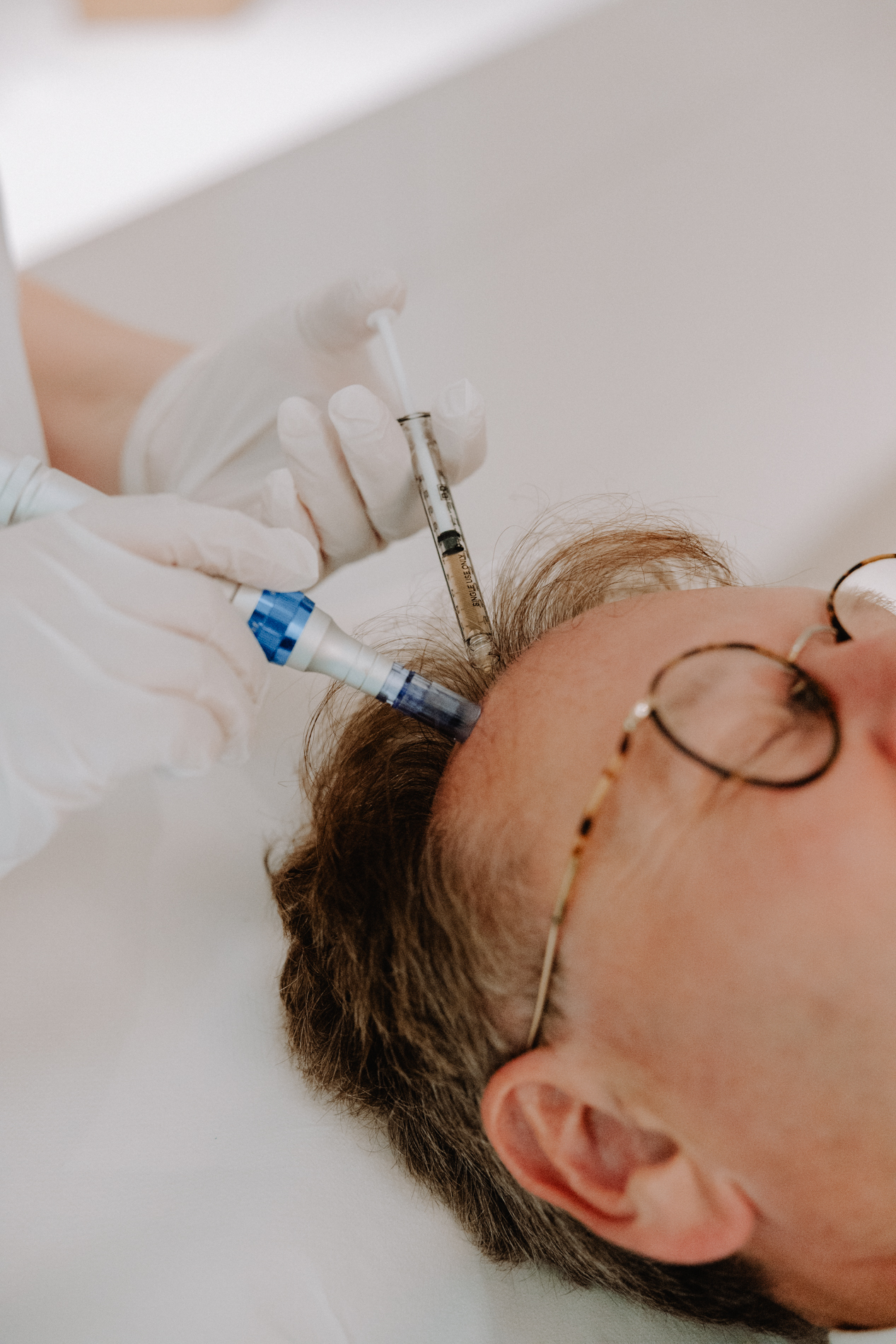
The benefits are many. PRP treatment can have a positive effect on both hair thickness and the condition of the hair and scalp.
Results can vary, but many patients notice improvement within a few months.
Some of the positive effects of PRP treatment for hair:


Can I help you?
Sarina Pierlé
For PRP hair or Platelet Rich Plasma treatment, you can consult Sarina Pierlé, a trained nurse with a strong dedication to patient care who aims to achieve her aesthetic goals. Sarina ensures that you once again enjoy a beautiful, full head of hair.
 Dutch, French, English

De prijs voor een PRP-injectie voor het haar bedraagt € 350 incl. btw.
Er wordt geadviseerd een kuur van 3 behandelingen te ondergaan met steeds 4-6 weken tussen elke behandeling. Om het effect te behouden is het best om minstens 1x/jaar een behandeling te ondergaan.
Zoals bij vrijwel elke injectabele behandeling bestaat de kans op bijwerkingen. Echter, door het gebruik van eigen bloedplaatjes tijdens de behandeling, is dit proces zeer veilig én vermindert bovendien het risico op infecties en allergische reacties.
Mogelijke bijwerkingen kunnen zijn:
Deze bijwerkingen verdwijnen meestal binnen enkele dagen na de behandeling.
Een tijdelijke minimale zwelling van het behandelde gebied is normaal. Ook zal de huid de eerste dagen een beetje trekkerig aanvoelen.
Testimonials